¶ Elements Reference For Google Sheets
This is the reference page for all the elements you can use in the Maven Documents Google Sheets templates. Here we provide basic information and the full list of available parameters.
Basic information contains the description of the element and covers the following qualities:
selfClosing. Represents whether an element is closed immediately, as opposed to standard HTML tags, which have both an opening and a closing tag.
The list of parameters differs from element to element. However, there are basic parameters common to every element:
| Parameter | Type | Description | isRequired | Default Value | Expression |
|---|---|---|---|---|---|
| name | string | Name of the element. | true | - | false |
| hidden | boolean | Determines whether the element is visible or hidden. | false | false | true |
The Expression column indicates whether an Expression can be used as that parameter's value.
¶ Repeater (mdoc:repeater)
The iteration component outputs the content of a collection according to a structure that you specify. The whole body of the Repeater element is shown for every record in the collection. This element can nest other elements, such as a Table, a Paragraph, or an Image, inside.
- selfClosing: false
There are two types of Repeaters available in the Template Builder in Google Sheets:
- Vertical. Repeat rows enclosed by the mdoc:repeater tag.
The starting column is the one where the opening tag is inserted, and the end column is the one defined under the lastCell parameter. If no value is provided, the end column defaults to the last column in the sheet. - Horizontal. Repeat columns enclosed by the mdoc:repeater tag.
The starting row is the one with the opening tag, and the end row is the one defined by the lastCell parameter. If no value is provided, the end column defaults to the last row in the sheet.
The Repeater's type is specified in the Direction parameter.
¶ Parameters
| Parameter | Type | Description | Required | Default Value | Expression |
|---|---|---|---|---|---|
| value | string | Collection of records to use in the Repeater. | true | - | true |
| variable | string | The current record in the iteration. | true | - | false |
| direction | string | The direction of the Repeater. Available values: vertical, horizontal. |
false | horizontal | false |
| lastCell | string | Depending on the direction of the Repeater it could be either the letter of the column or the number of the row. | false | - | true |
¶ Example
-
Vertical Repeater in the document looks like the following:
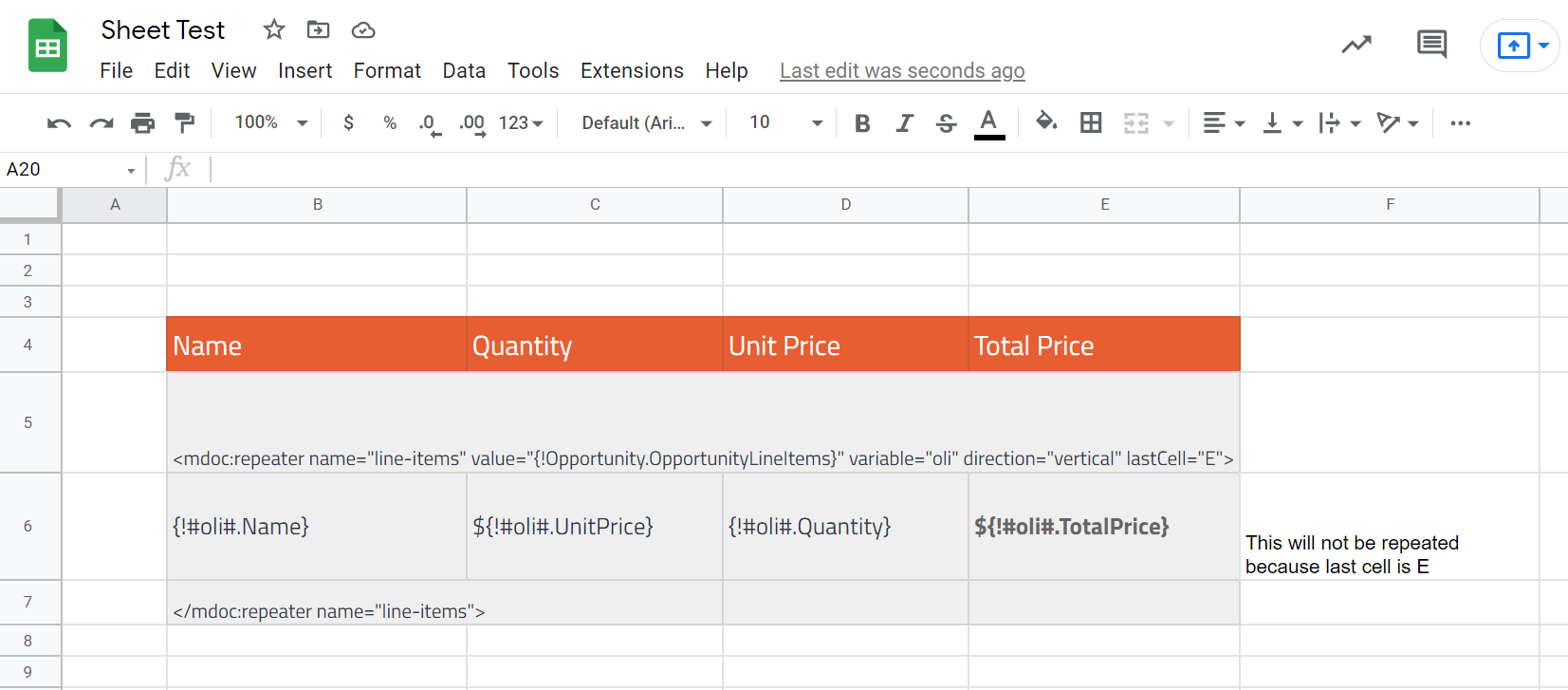
The hash # symbol is used to wrap around the oli Variable referenced inside Vertical Repeater.
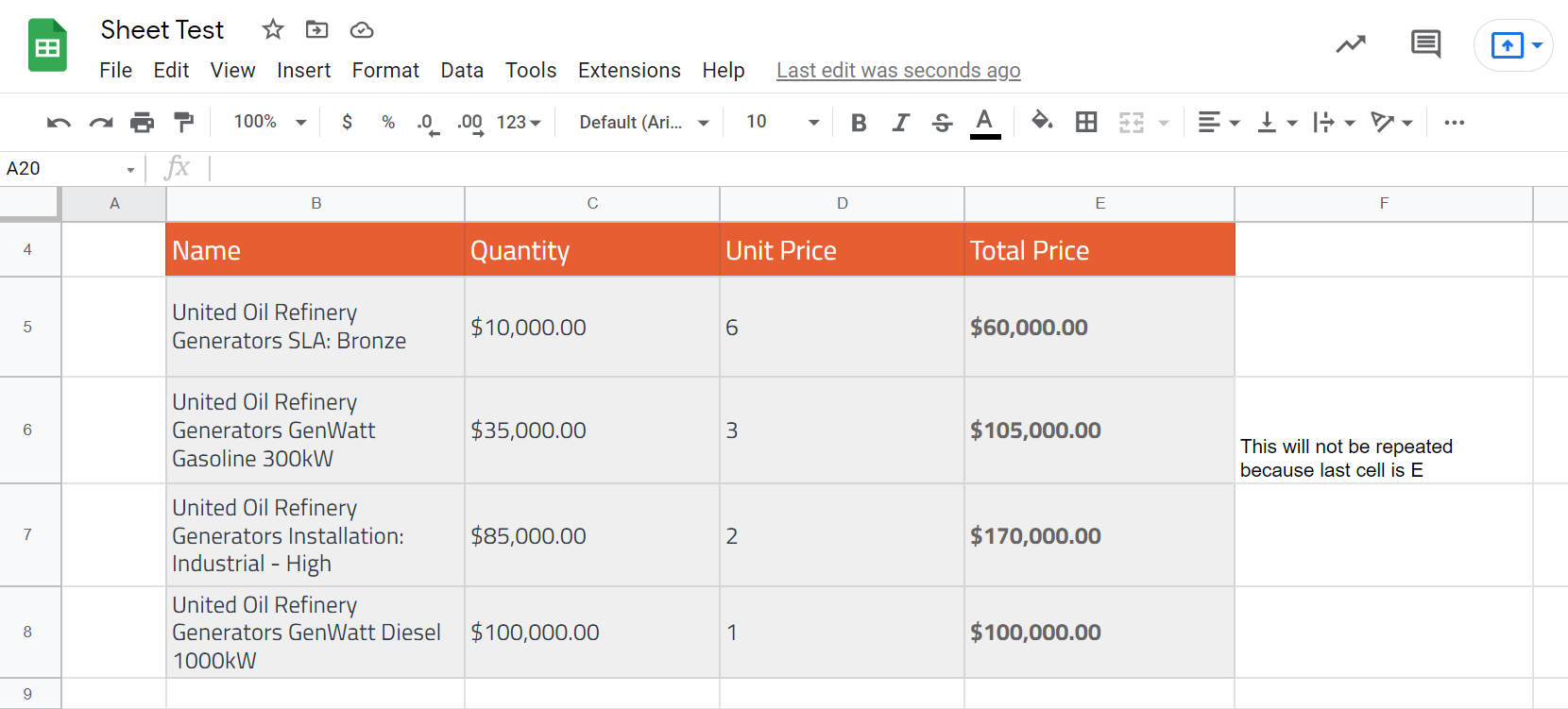
The outcome of the Repeater from above:
-
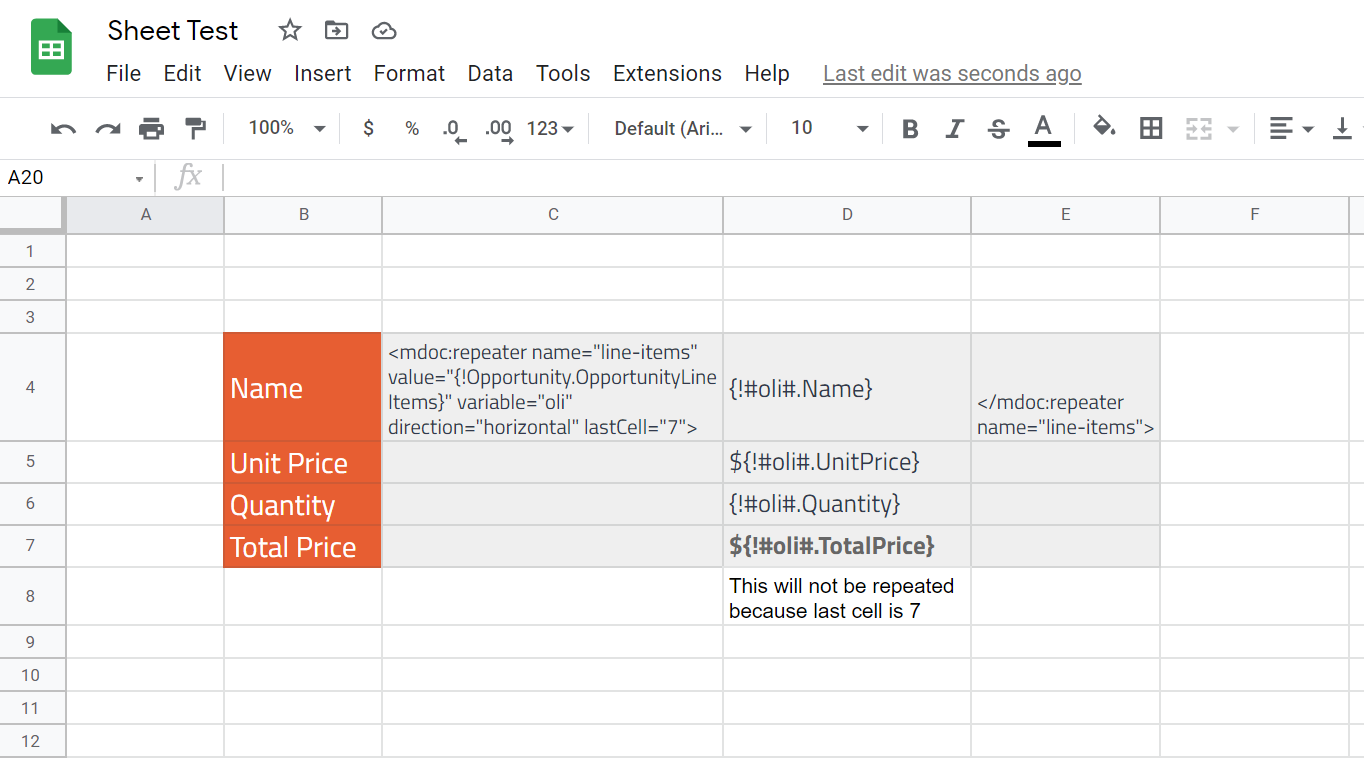
The example of the equivalent Horizontal Repeater:
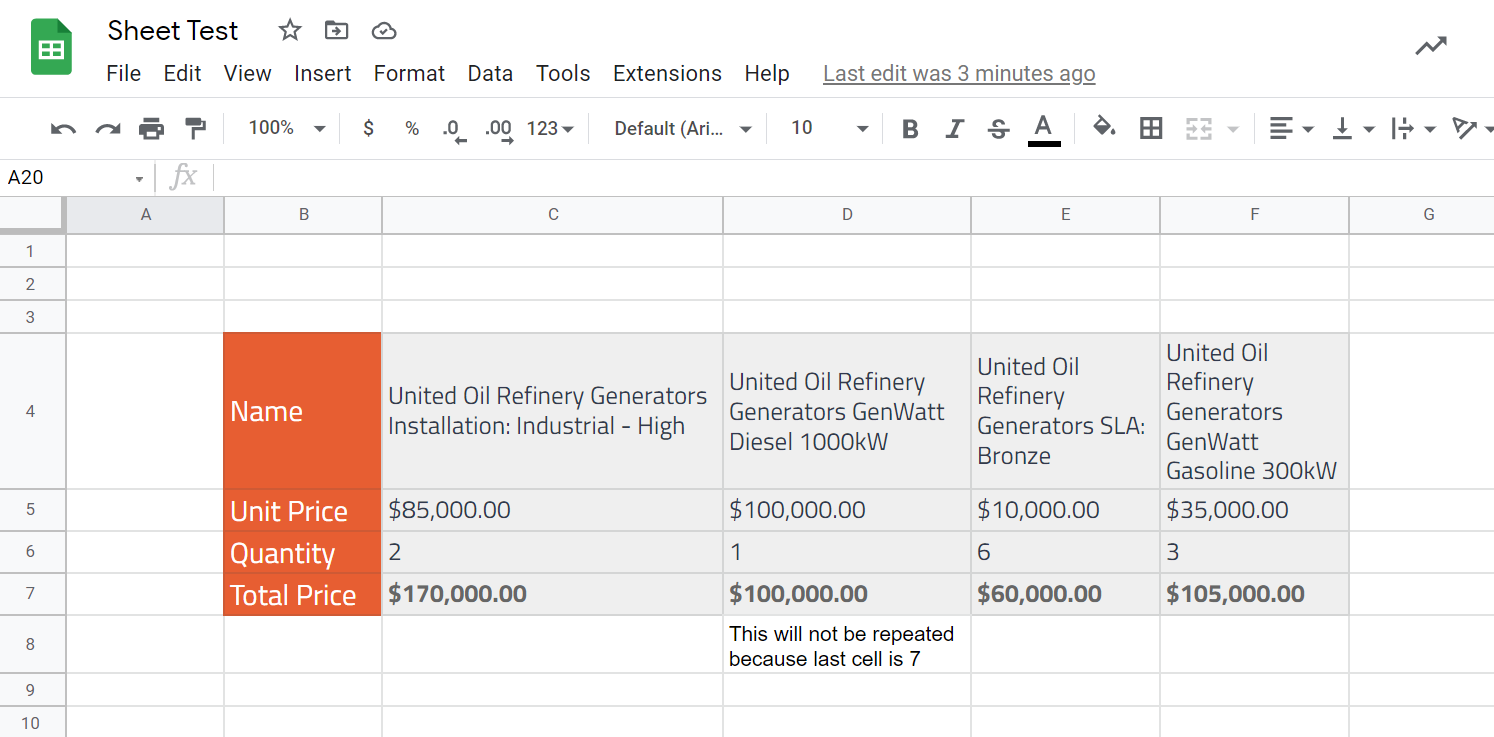
It generates the following table:
There is also an option to use the Index expression inside the Repeater. This expression returns the index of the repeating variable inside the Repeater.
¶ Image (mdoc:image)
This element allows you to render an image from the specified URL or base64 data.
- selfClosing: true
¶ Parameters
| Parameter | Type | Description | Required | Default Value | Expression |
|---|---|---|---|---|---|
| source | string | The merge field that holds base64 data or the URL of the image. Or the URL/base64 data of the image itself. | true | - | true |
| width | integer | Width of the image in pixels. | false | - | true |
| height | integer | Height of the image in pixels. | false | - | true |
| insideCell | boolean | Determines whether the image is rendered within a cell. | false | false | true |
| mode | integer | Determines the sizing mode for the image. Available only if Inside Cell is true. Available values: fit, fill, original. |
false | fit | true |
The Mode parameter can have one of the following values:
- fit. Resize the image to fit inside the cell, maintaining the aspect ratio.
- fill. Stretch or compress the image to fit inside the cell, ignoring the aspect ratio.
- original. Leave the image at its original size, which may cause cropping.
When Inside Cell is marked, and no Mode is defined, the rendered image uses the fit Mode by default. However, if height and width are specified, then the Mode parameter value is ignored.
- If the src value is base64 data, the Inside Cell parameter should be false. Otherwise, the image won't be rendered.
- If the image you would like to render is a "big" image, the Inside Cell parameter should be true. Otherwise, the generation will fail. "Big" means the 1M pixels resoultion or 2MB size.
¶ Example
Here we have a few different examples of the Image element:
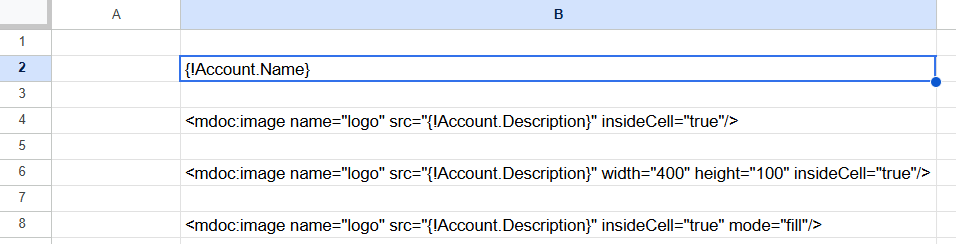
Here is the outcome in the generated document:

You can use the Image element to place charts into the document. Here is a tip on how to do it.
¶ Code (mdoc:code)
Renders various types of codes such as QR Codes, Barcodes, etc.
- selfClosing: true
¶ Parameters
| Parameter | Type | Description | Required | Default Value | Expression |
|---|---|---|---|---|---|
| type | string | Code type. | true | - | true |
| value | string | The merge field holds a value that is replaced with the code image. | true | - | true |
| scale | integer | The scale of the rendered code. Must be an integer > 0. | false | 2 | true |
| rotate | string | Defines the rotation of the code image to one of the four orthogonal orientations. Available values: N, R, L, I. |
false | N | true |
| includeText | boolean | Displays text below the code for some code types (e.g. code128). | false | false | true |
| insideCell | boolean | Determines whether the code image is rendered within a cell. | false | false | true |
| mode | integer | Determines the sizing mode for the code image. Available only if Inside Cell is true. Available values: fit, fill, original. |
false | fit | true |
Rotation values:
- N. Normal, not rotated.
- R. Clockwise, right.
- L. Counter-clockwise, left.
- I. Inverted.
Mode and insideCell behave the same as in the Image element.
¶ Example
Here are a few examples of the Code element:

Here is the rendered document:
